Abstract
Open-ended discovery requires learning from repeated attempts while continuing to explore directions whose value is not yet apparent. Search with a frozen large language model (LLM) can reuse previous solutions in context, but cannot update the model from its successes and failures on the test problem. Reinforcement learning (RL) enables such adaptation; however, strongly favoring high-reward trajectories may suppress low-reward yet potentially promising directions too early.
We introduce CURIO, a curiosity-driven test-time learning framework that complements task feedback with an Intrinsic Curiosity World Model (ICWM). The ICWM learns transitions in the policy's hidden-state representation and supplies prediction-error bonuses at sampled tokens outside the policy's top-$k$ choices. Epoch normalization and an annealed weight regulate their contribution to the policy update.
On six mathematical discovery tasks and single-cell denoising with Qwen3 backbones from 8B to 235B, three-run means improve over a matched task-only RL control on five mathematical objectives, match the best reported performance on Circle Packing, and improve denoising Score and mean squared error (MSE) on both held-out corpora at every tested scale. Relative gains reach 18.3% on Hadamard and 10.8% on denoising Score. Code-diversity measurements show greater structural variation among generated programs, supporting curiosity as a complementary exploration signal for learning in open-ended discovery.
How It Works
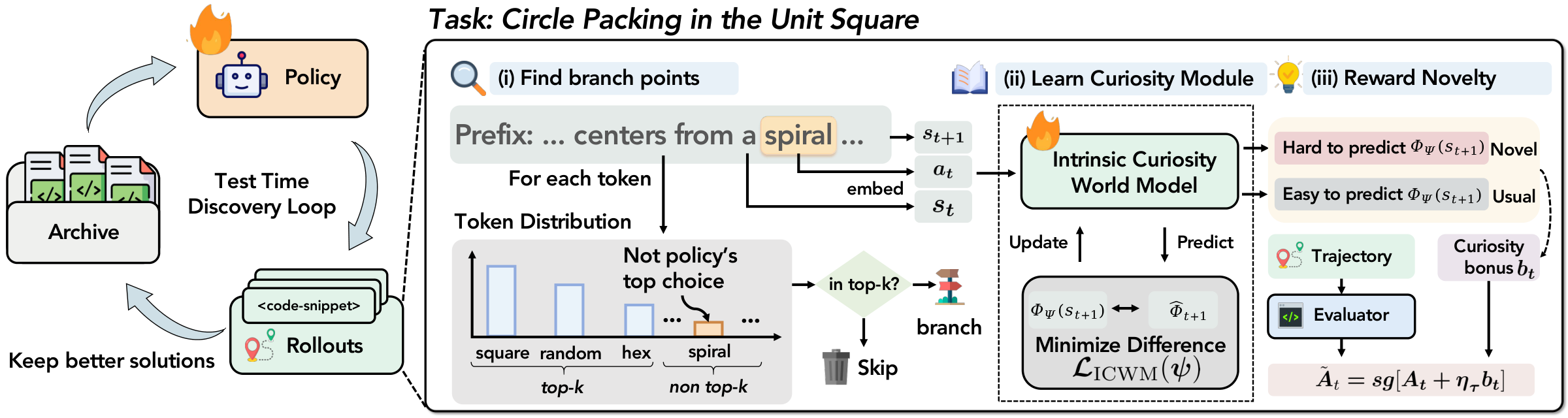
CURIO follows the test-time RL discovery loop: a policy expands parents from an archive into rollouts, an evaluator scores them, the archive keeps the better solutions, and the policy is updated on the same problem. On top of the task reward, CURIO learns where the policy is surprising itself and rewards exploration exactly there.
During generation, CURIO records which sampled tokens fall outside the policy's top-$k$ choices. These departures from the most likely continuation are the only places where the curiosity bonus is applied.
An encoder and forward predictor learn $s_t, a_t \rightarrow s_{t+1}$ over the current actor's last-layer hidden states and token embeddings. Its prediction error marks transitions the policy has not yet learned to anticipate.
Residuals are normalized per epoch and added to the task coefficient with weight $\eta_\tau$, cosine-annealed to a floor. Setting $\eta_0 = 0$ recovers the task-only TTT-Discover update exactly.
Main Results
We compare against frozen-LLM search (AlphaEvolve via OpenEvolve, ShinkaEvolve, Best-of-25600, SimpleTES) and trainable test-time RL (ThetaEvolve, TTT-Discover). TTT-Discover is the matched task-only control: the same procedure as CURIO with $\eta_0 = 0$. All results are means over three runs.
| Method | Erdős ↓ | AC1 ↓ | AC2 ↑ | AC3 ↓ | Circle Packing ↑ | Hadamard ↑ |
|---|---|---|---|---|---|---|
| Qwen3-8B | ||||||
| AlphaEvolve | 0.381002 | 1.50561 | 0.8947 | 1.5062 | 2.63585 | 0.5589 |
| ThetaEvolve | 0.380999 | 1.50649 | 0.9449 | 1.4942 | 2.63597 | 0.5748 |
| ShinkaEvolve | 0.381026 | 1.51493 | 0.8501 | 1.5074 | 2.63597 | 0.5661 |
| Best-of-25600 | 0.381091 | 1.51032 | 0.9318 | 1.5081 | 2.63570 | 0.5554 |
| SimpleTES | 0.381006 | 1.50628 | 0.9458 | 1.4951 | 2.63597 | 0.5776 |
| TTT-Discover | 0.380995 | 1.50546 | 0.9463 | 1.4935 | 2.63598 | 0.5809 |
| CURIO | 0.380932 | 1.50513 | 0.9481 | 1.4846 | 2.63598 | 0.6048 |
| Qwen3-14B | ||||||
| AlphaEvolve | 0.381068 | 1.50971 | 0.9158 | 1.5109 | 2.63482 | 0.5762 |
| ThetaEvolve | 0.383710 | 1.51488 | 0.9351 | 1.6428 | 2.62491 | 0.5867 |
| ShinkaEvolve | 0.381041 | 1.51052 | 0.9048 | 1.4996 | 2.63509 | 0.5826 |
| Best-of-25600 | 0.381119 | 1.50997 | 0.9271 | 1.5051 | 2.63439 | 0.5708 |
| SimpleTES | 0.381009 | 1.50819 | 0.9374 | 1.4879 | 2.63546 | 0.5902 |
| TTT-Discover | 0.380979 | 1.50608 | 0.9391 | 1.4592 | 2.63598 | 0.5864 |
| CURIO | 0.380919 | 1.50591 | 0.9418 | 1.4578 | 2.63598 | 0.6061 |
| Qwen3-235B | ||||||
| TTT-Discover | 0.380918 | 1.50376 | 0.9562 | 1.4561 | 2.63598 | 0.7846 |
| CURIO | 0.380880 | 1.50315 | 0.9588 | 1.4549 | 2.63598 | 0.9284 |
Best feasible objective found per run, averaged over three runs. ↓ lower is better, ↑ higher is better. Within each scale, bold is best and underline is second-best; ties share the marking.
| Method | PBMC | Tabula | ||||
|---|---|---|---|---|---|---|
| Score ↑ | MSE ↓ | Poisson ↓ | Score ↑ | MSE ↓ | Poisson ↓ | |
| Qwen3-8B | ||||||
| AlphaEvolve | 0.6738 | 0.1817 | 0.0554 | 0.6785 | 0.1716 | 0.0323 |
| ThetaEvolve | 0.6981 | 0.1588 | 0.0494 | 0.7207 | 0.1441 | 0.0302 |
| ShinkaEvolve | 0.6787 | 0.1764 | 0.0535 | 0.6881 | 0.1669 | 0.0312 |
| Best-of-25600 | 0.6274 | 0.2071 | 0.0607 | 0.6382 | 0.1968 | 0.0354 |
| SimpleTES | 0.6958 | 0.1641 | 0.0503 | 0.7118 | 0.1514 | 0.0305 |
| TTT-Discover | 0.6842 | 0.2087 | 0.0818 | 0.6468 | 0.1963 | 0.0363 |
| CURIO | 0.7009 | 0.1552 | 0.0493 | 0.7165 | 0.1485 | 0.0301 |
| Qwen3-14B | ||||||
| AlphaEvolve | 0.6684 | 0.1821 | 0.0504 | 0.6586 | 0.1824 | 0.0302 |
| ThetaEvolve | 0.6814 | 0.1678 | 0.0503 | 0.6892 | 0.1586 | 0.0302 |
| ShinkaEvolve | 0.6782 | 0.1715 | 0.0502 | 0.6783 | 0.1618 | 0.0301 |
| Best-of-25600 | 0.6171 | 0.2023 | 0.0506 | 0.6576 | 0.1822 | 0.0303 |
| SimpleTES | 0.6873 | 0.1651 | 0.0499 | 0.6966 | 0.1558 | 0.0302 |
| TTT-Discover | 0.6901 | 0.1615 | 0.0492 | 0.7012 | 0.1526 | 0.0301 |
| CURIO | 0.7052 | 0.1555 | 0.0491 | 0.7218 | 0.1423 | 0.0292 |
| Qwen3-235B | ||||||
| TTT-Discover | 0.7011 | 0.1562 | 0.0491 | 0.7254 | 0.1401 | 0.0291 |
| CURIO | 0.7156 | 0.1501 | 0.0490 | 0.7408 | 0.1334 | 0.0281 |
The epoch is selected by held-in MSE; neither held-out corpus is used for selection. Means over three runs.
CURIO improves on TTT-Discover for Erdős, AC1–AC3, and Hadamard at every tested scale, matches the best reported performance on Circle Packing, and improves denoising Score and MSE on both held-out corpora. The largest gain is on Hadamard at 235B (+18.3%).
Analysis
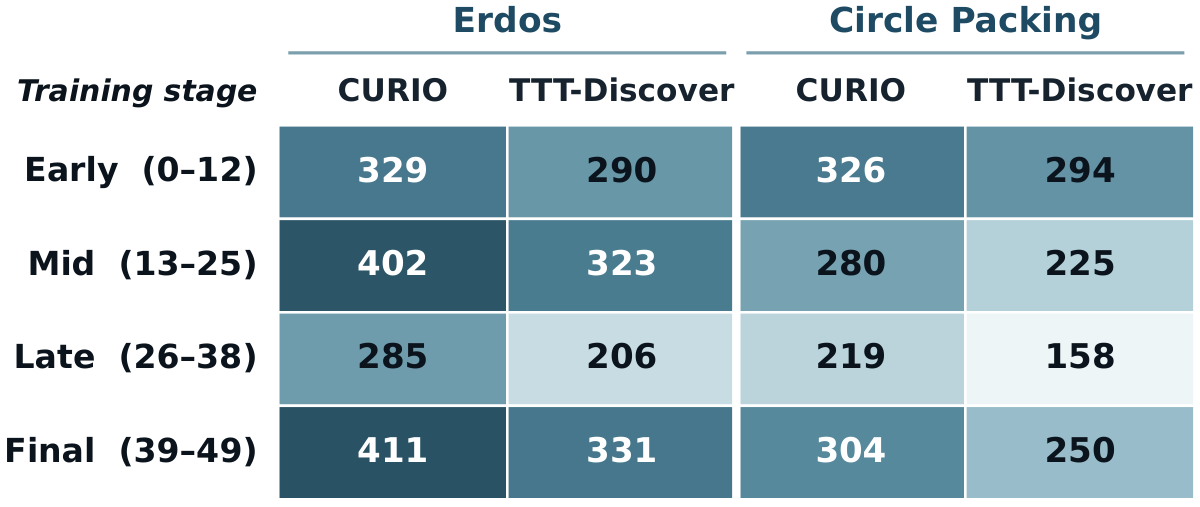
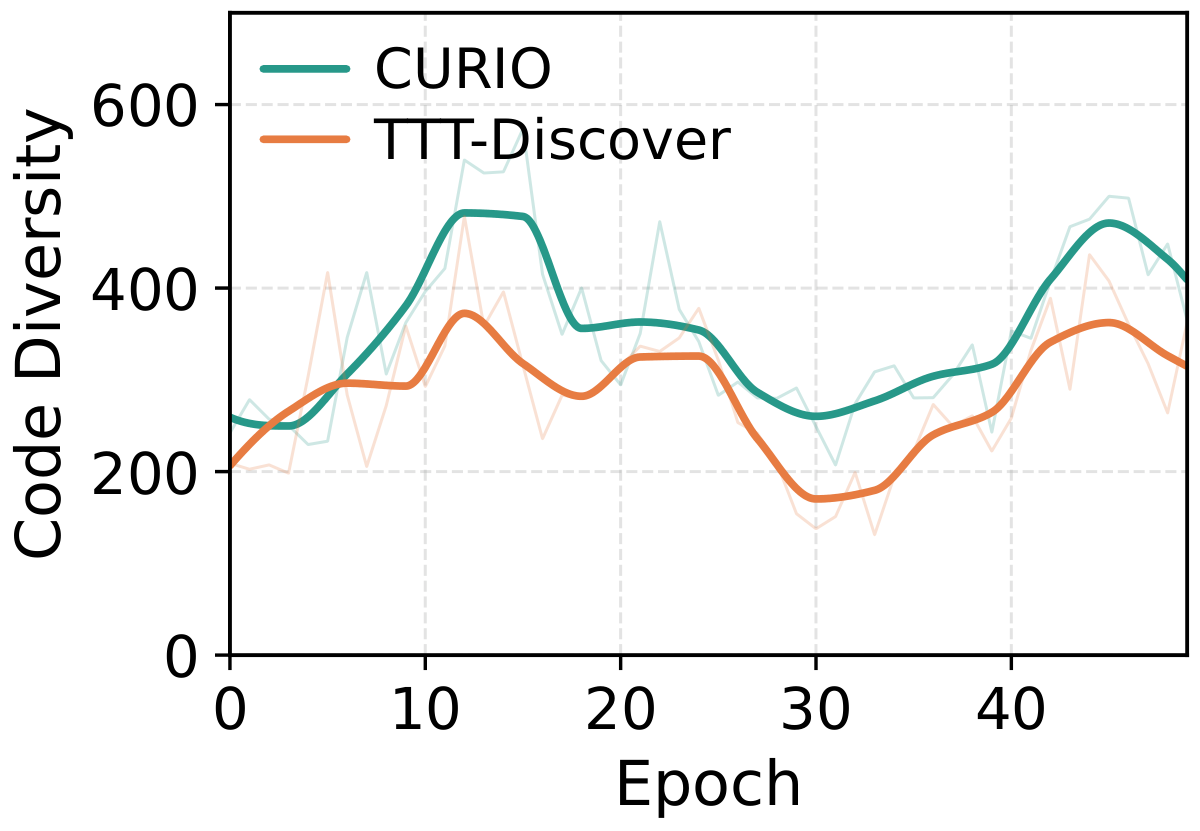
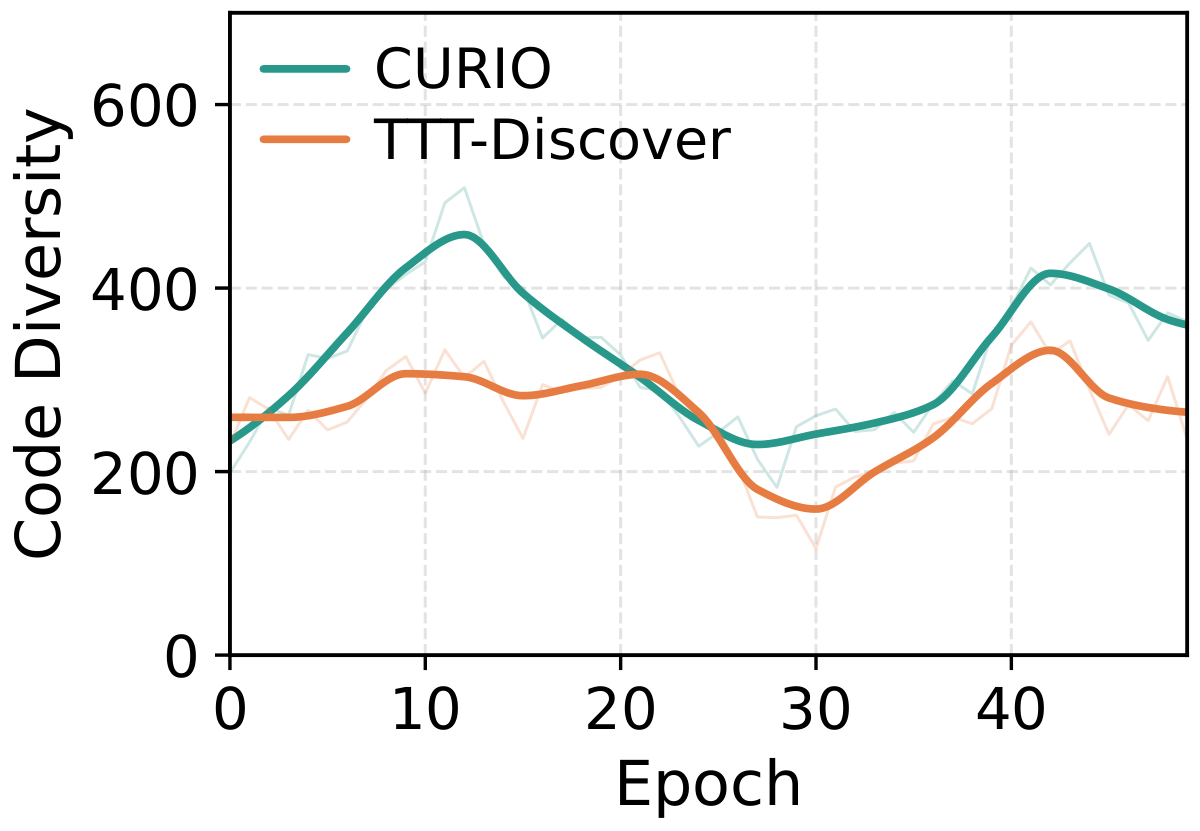
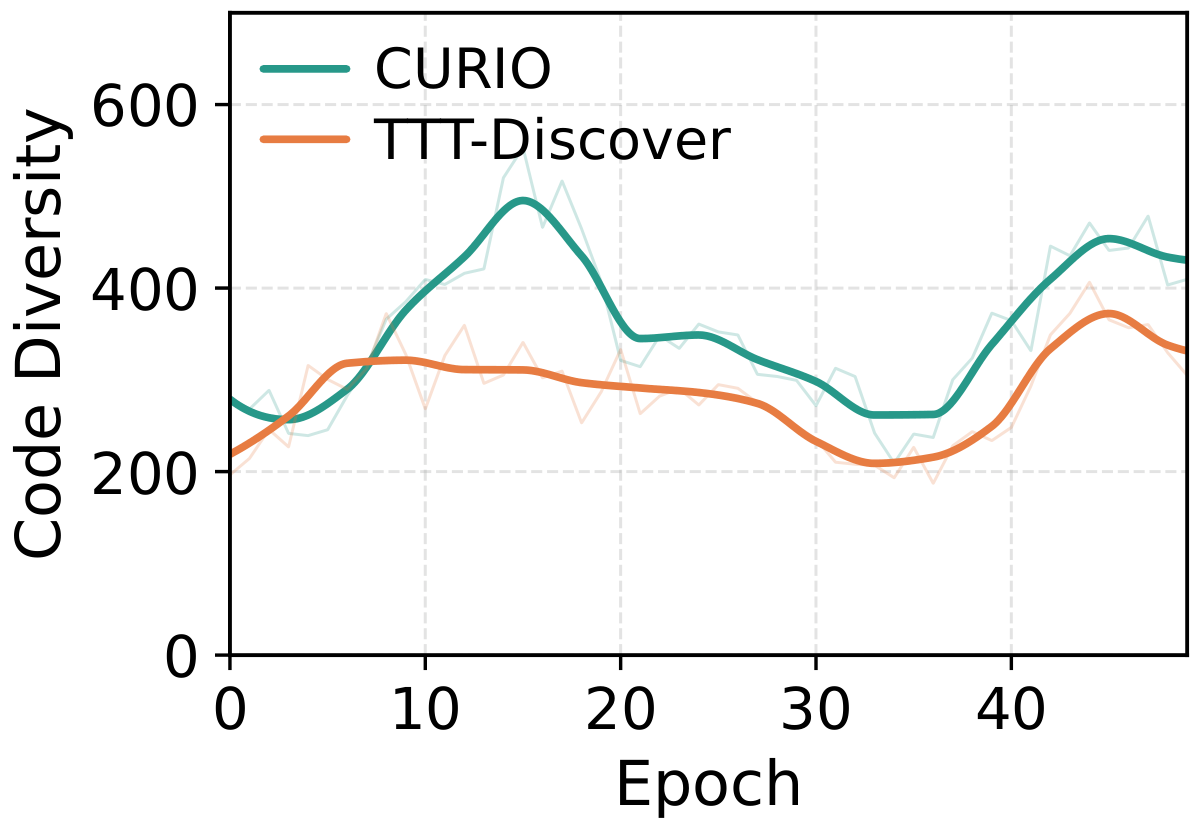
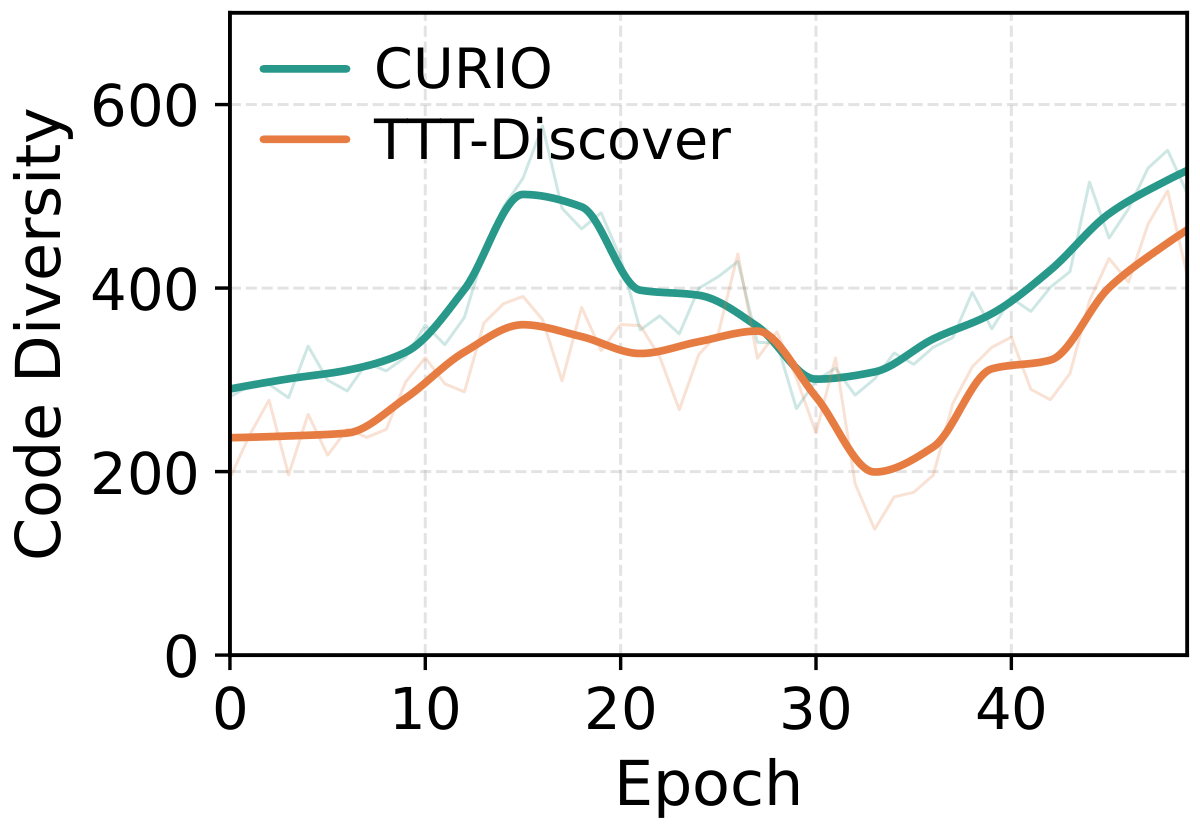
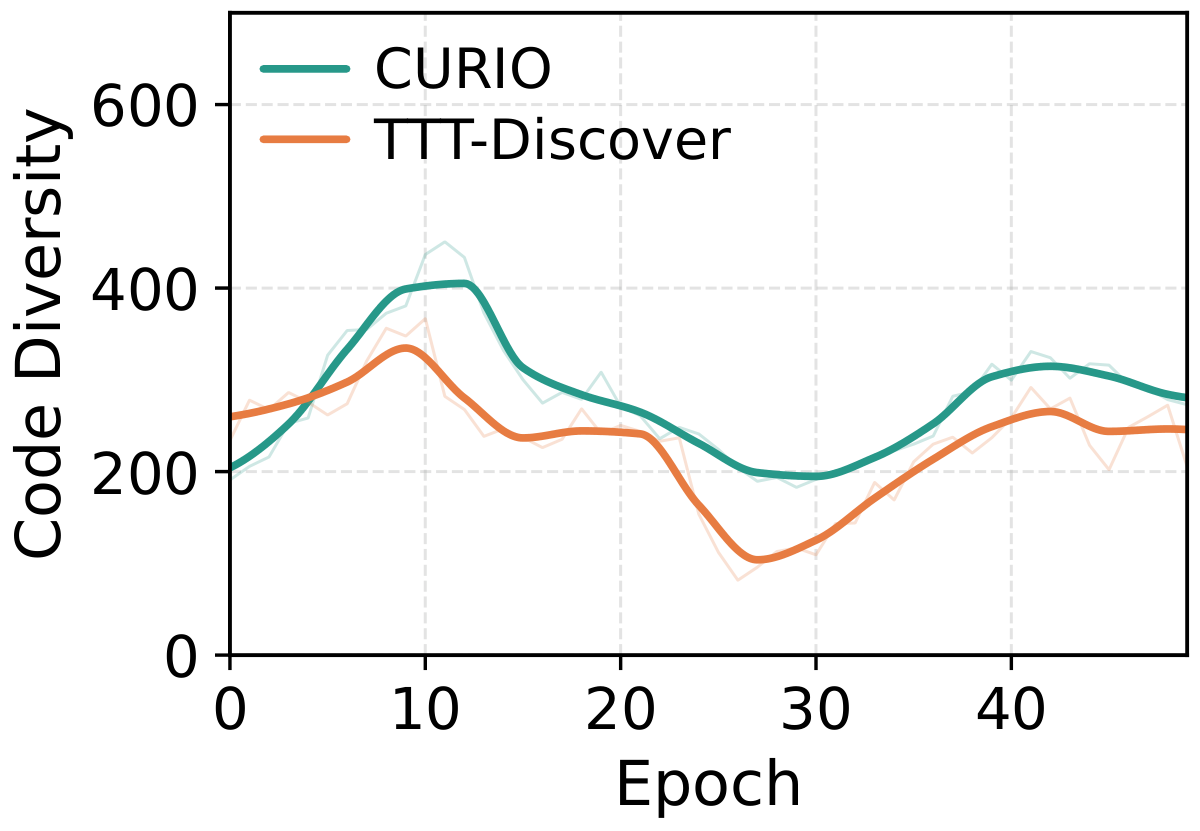
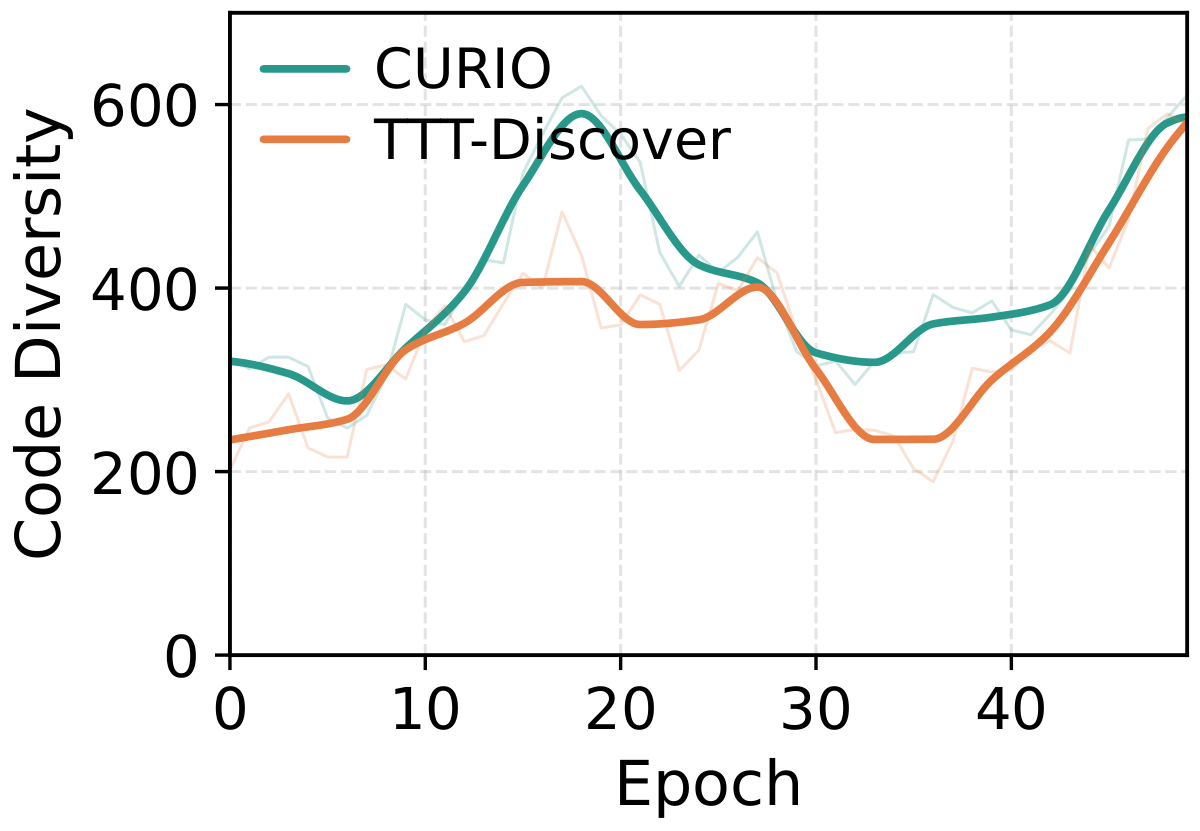
We measure code-level structural variation among generated programs with OpenEvolve's island code-diversity metric, which compares pairs of programs by differences in code length, line count, and character sets. CURIO generally maintains higher diversity than TTT-Discover over training. This is a code-level diagnostic: it does not by itself establish semantic diversity of the underlying constructions.


Ablations
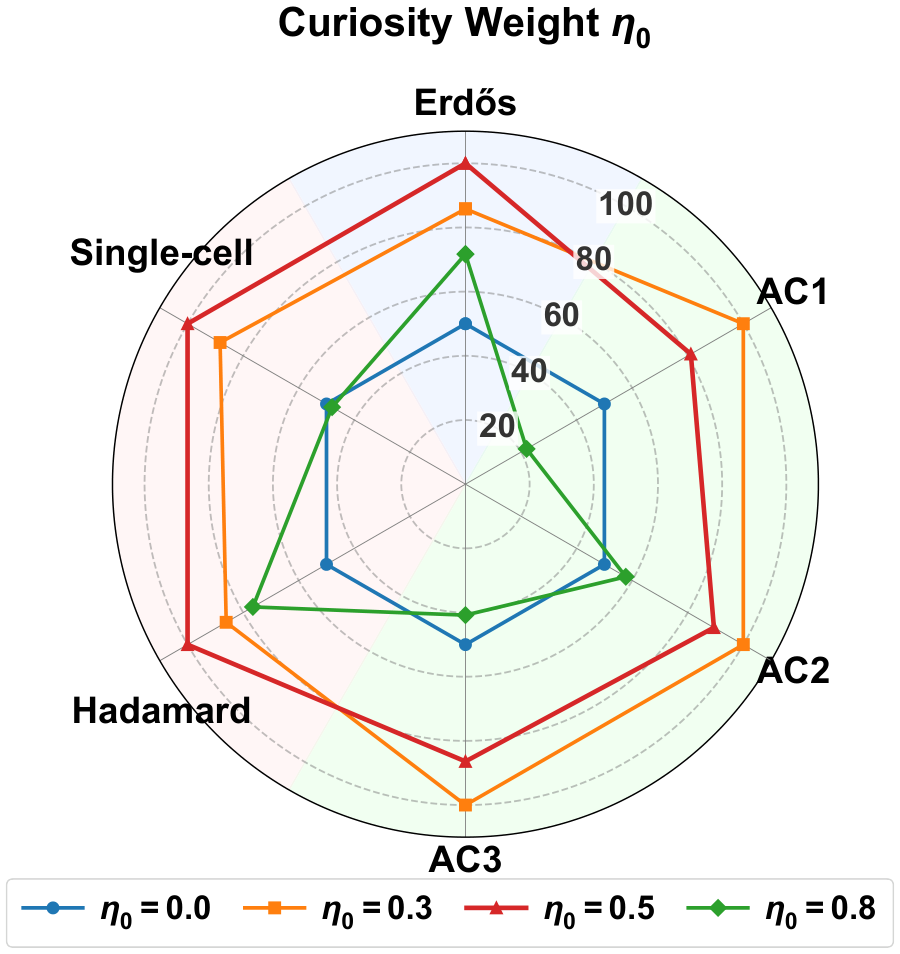
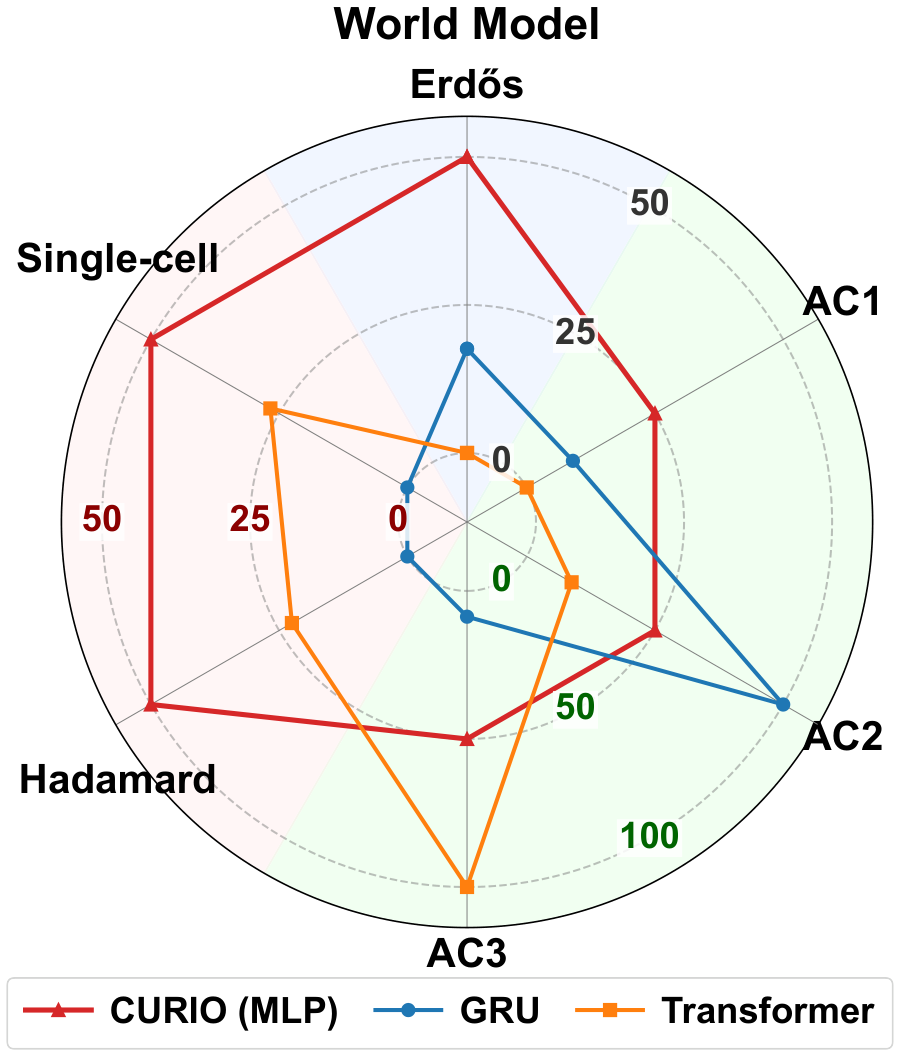
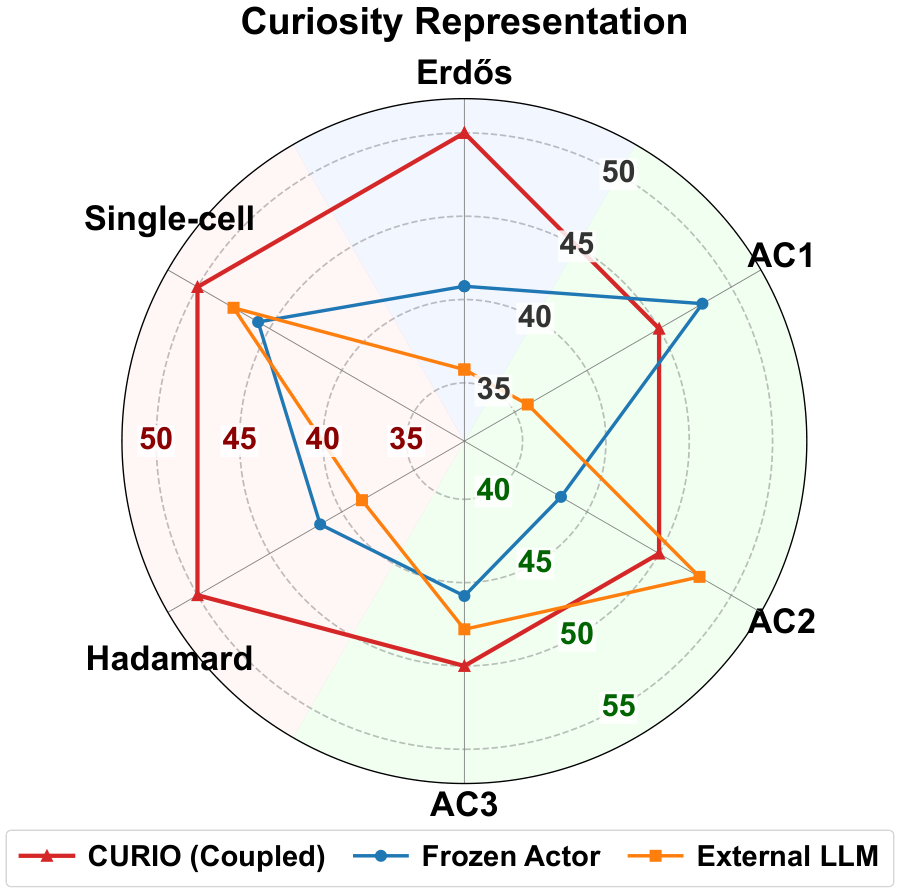
On Qwen3-14B across six tasks, we vary three design choices of the ICWM. Each panel fixes its reference configuration at 50 on every task, so values above 50 indicate improvement and values below 50 indicate degradation.
$\eta_0 = 0.3$ is best on the autocorrelation tasks and $\eta_0 = 0.5$ on Erdős, Hadamard, and denoising. The largest weight, $0.8$, underperforms the task-only control on some tasks.
The default MLP forward predictor is competitive with GRU and Transformer alternatives; the best architecture depends on the task.
Reading states from the current actor leads on most tasks, compared with a frozen initial actor or a frozen external LLM.
Get Started
CURIO runs fully locally: generation on Ray Data LLM (vLLM) and LoRA training on DeepSpeed, with resumable per-stage checkpoints and launchers for single nodes and SLURM clusters. See the repository for setup, the required Ray patch, and all configuration options.
git clone https://github.com/ft2023/CURIO.git && cd CURIO
source .venvs/curio-runtime/bin/activate
export CURIO_ERDOS_CONFIG=qwen3_8b_2xH100
export CURIO_EVAL_PYTHON=$PWD/.venvs/curio-eval-erdos/bin/python
export CURIO_LOG_ROOT=/path/to/your/log/root
bash tasks/erdos/launchers/single_node/run_all.sh
@article{feng2026curio,
title = {CURIO: Curiosity-Driven Test-Time Learning for Open-Ended Discovery},
author = {Feng, Tao and Yu, Fangxu and Lei, Zijie and Zou, Jiaru and Jiang, Changjiang and Yan, Yi and You, Jiaxuan and Lu, Pan},
journal = {arXiv preprint},
year = {2026}
}